Category Archives: autoethnography

BU Residential 2015 (5th & 6th June)

Full photo set you can access via Flickr (2015):

https://www.flickr.com/photos/131988099@N03/sets/72157654173611326/

IMG_0289 IMG_0288 IMG_0286 IMG_0285 IMG_0290 IMG_0273 IMG_0281

Practice Viva (went horrifyingly bad and indicated I need some acting/ performance lessons from my brother!).

Happy to write about what is in my head, harder to verbalise formally, an unnatural process for me.

Presentation at BU Business Centre on my Pilot Study findings (self-assessment: 2nd attempt demonstrated some progress but requires more work).

I need to keep doing this, putting myself through these tests regardless of how painful they are in reality to do (and uncomfortable to watch). Facing one’s demons is very much part of the Doctoral process for me. Otherwise no point.

Revisiting Literature

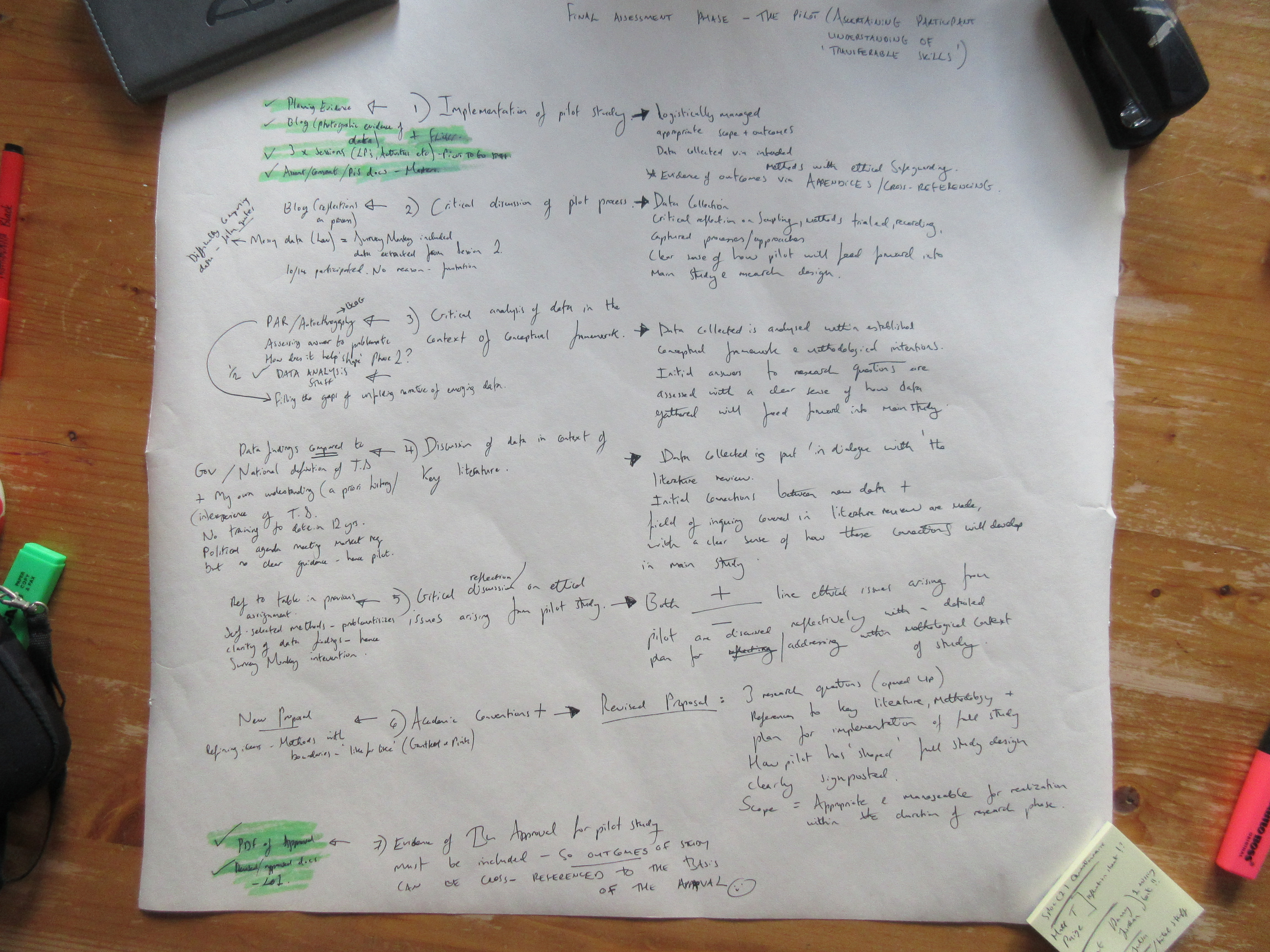
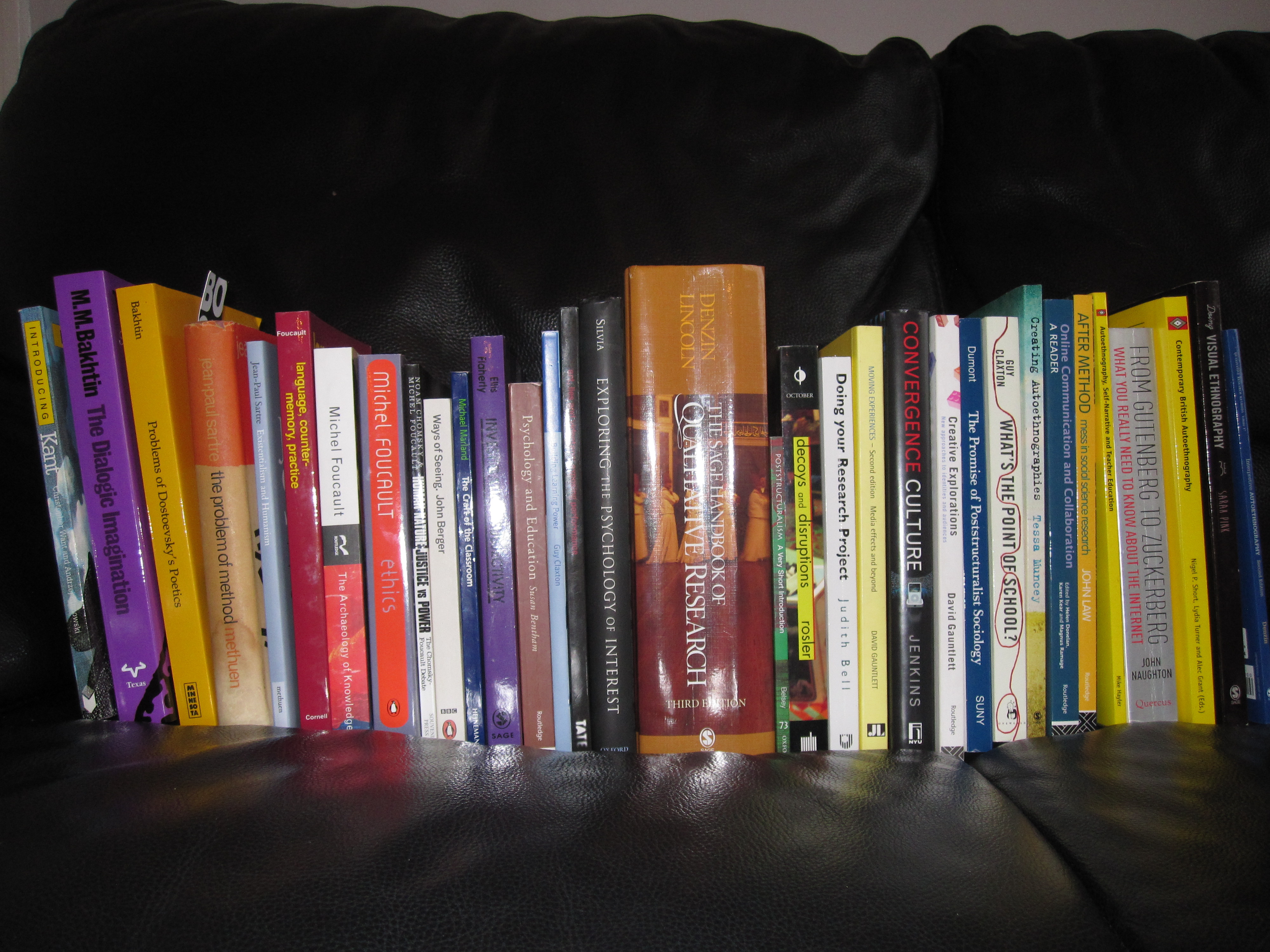
I have needed to do extra reading, namely Research Methods in Education by Cohen, Manion & Morrison (2011) on participatory action research and devising questionnaires. The latter because my methodology changed and my originally planned Reflecting Data session changed format from paper-based to an online survey. Although the BU Ethics panel approved this decision, I need to think about why the decision became apparent mid-way through my pilot.

Adapting Methods Accordingly

Additional clarity of Session 2 findings proved necessary precisely because I made the choice to allow participants to produce data in any way they saw fit. On analyses, around 50% of the data collected proved unusable as it failed to answer my question with sufficient coherency (even with participant reflection), raising questions of over stretching participants or perhaps not being sufficiently clear on the research objective. The 50% that proved unusable opted for narrative/ text-based or 3D models to provide their explanation and within that data some participants raised the issue that they found it difficult to define. Consequently, participant confusion on actually defining the term contributes to the justification of the project even though participants failed to coherently identify any key transferable skills for the purposes of the key research question.

Problems of Duality of Role – The Researcher-Teacher

Thinking back over all three planned sessions, maybe too many questions were asked of participants in the build up to the making data session. The pre-research session was designed to open up participant ideas on other possible avenues for primary research. Participants know what a questionnaire, interview and focus group are but they had never thought about creating or selecting images or film quotes even as research, had not thought about using Play-Doh or Lego to express ideas metaphorically. I guess Session 1 was more about me trying to transfer some of my interest for thinking about research methods differently onto my students. I confused the student/ participant role here I think.

Interestingly, when I asked (in Session 3) if participants would use the same method (if they were to participate in similar research) again, the majority (over 80%) said they would elect to use the same method… but at the cost of additional researcher confusion, further questions and a newly designed online survey.

I wanted the process to be democratic and autonomous. I wanted to avoid forced methods. As their teacher, I did not want their experience of the research process itself to be laborious, a chore. I wanted participants to enjoy it and they did (well 90% stated that they did) but I will never really know if they have stated that because I am their teacher.

Also, recently, I have returned to John Law’s After Method (2004) as he acknowledges key issues on methodological (un)certainty of social science data. His book instills a confidence in me to see this project through and to bear in mind all the grey areas involved in human behaviour/ inquiry of this kind.

My mantra for this journey, inspired by his work is as follows:

Remaining open to change, embracing the messiness of human inquiry, going with the tide and seeking connections in the natural order.

Friday 13th March 2015 – The Day of the Pilot – I am not superstitious.

Whilst writing this, it feels really strange having planned the pilot to be sitting in another room away from the research activities taking place. I was worried the facilitator might not turn up, she did. I was worried that my students would be absent, they weren’t. It has taken a year and a half of planning to find myself isolated in my staff room.

The BU Ethics panel proved a difficult process. The relief of my project being approved can only be explained in my physical well being (I have broken out in rashes on my wrists and chin, I have a boil on my cheek and my vertigo has returned).

When I saw that the BU chair approval email had come through, it was like being given a teabag after not having a cup of tea for at least a year.

I had anticipated that all my students would participate but only 10 out of 14 did. Two said it was because they had too much work to do and the others just quite simply refused point blank with no reason offered. A year and a half of working towards an approved proposal and two of my students just didn’t want to take part. It felt like a kick in the teeth but it reminded me that as a researcher you can never take anything for granted. I need this blog as doing a professional Doc can be extremely isolating at times.

Need to sign off for now as the pilot session will wrap within the next 10 minutes or so and I need to be ready to collate data produced today. Exciting to feel like a real researcher at last – even though I am not present.

‘Gizza Job’

The infamous ‘Gizza job’ phrase seems just as (if not more) relevant now as what it meant in 1980’s Liverpool. Historically I come from generations of dockers who lived with this reality on a daily basis. Survival in this respect is built into my DNA.

The increasingly popular proliferation of zero hour contracts in education, of not knowing what each new day would bring in terms of teaching hours is a song we all now sing. The days of permanency and of the security that brings rapidly becoming a thing of the past. The strength of trade union support becoming a thing of nostalgia, a part of British social and economic history now dead.

In FE, my role is to prepare students for employment and this is why I believe ‘transferable skills’ are key to this happening yet ironically my own position in the employment market is just as uncertain and vulnerable as theirs. The ability to identify my own transferable skills are equally important. Adapting to the speed of an ever shifting cultural economy is now something we all have to face. It affects the student and teaching community. We are all in this boat together as we so often hear on news reports. Therefore, strategies are needed so that people sail through the turbulent, fragile seas and make it to shore.

This project represents my attempts at moving beyond survival for surviving alone is just not good enough anymore.

Memories and Fragments of a Professional Doctorate (Creative and Media)

‘An Autoethnographer’s Tale’ will walk beside me here on my doctorate journey, it will hopefully become a neutral friend, an ear that never tires. As the title indicates, although partial, this is my tale, my truth.  At times I will explain items posted (be they random thoughts, photos, music…) others maybe not but all posts will be connected in some way to my research and the people I meet along the way. ‘An Autoethnographer’s Tale’ represents my attempt at bridging together the different narratives at play during my research including what I call the there C’s (namely the conflicts, contradictions and confessions) whilst I juggle my research endeavours, academic writing, student life and motherhood. I began this journey back in October 2013 so I am currently approaching the midpoint of year 2 (of a 4 year programme) on the taught ProfDoc at Bournemouth University. It has taken this time for me to feel ready to write and reflect in this way.